
 |
 |
 |
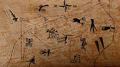
Nazca Lines
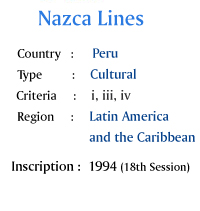
UNESCO World Heritage Site in 1994:
The Nazca Lines are a series of ancient Geoglyphs (a geoglyph is a large design or motif (generally greater than 4 meters) produced on the ground and typically formed by rocks or similarly durable elements of the geography, such as stones, stone fragments, gravel, or earth) located in the Nazca Desert in southern Peru.
Heritage Site:
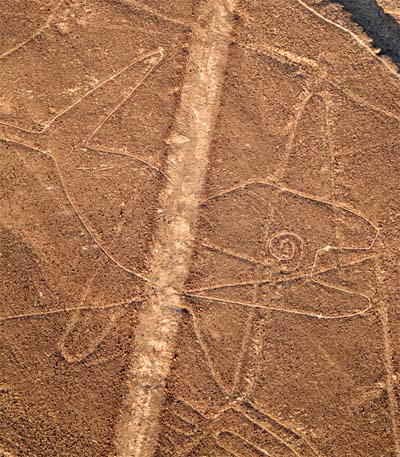
They were designated a UNESCO World Heritage Site in 1994. The high, arid plateau stretches more than 80km (50 miles) between the towns of Nazca and Palpa, about 400 km south of Lima. Scholars believe the Nazca Lines were created by the Nazca culture between 400 and 650 AD.The hundreds of individual figures range in complexity from simple lines to stylized humming-birds, spiders, monkeys, fish, sharks, orcas, llamas, & lizards. The lines are shallow designs made in the ground by removing the omnipresent reddish pebbles and uncovering the whitish ground beneath.
Hundreds of them are simple lines or geometric shapes; more than seventy are zoomorphic designs of animals such as birds, fish, llamas, jaguar, monkey, or human figures. Other designs include phytomorphic shapes such as trees and flowers. The largest figures are over 200 metres (660 ft) across. Scholars differ in interpreting the purpose of the designs, but in general they attribute religious significance to them. The geometric ones could indicate the flow of water or be connected to rituals to summon water. The spiders, birds, and plants could be fertility symbols.
Other possible explanations include: irrigation schemes or giant astronomical calendars.
Due to the dry, windless, and stable climate of the plateau and its isolation, for the most part the lines have been preserved. Extremely rare changes in weather may temporarily alter the general designs.
Discovery:
After people travelled over the area by plane in the 1930s and saw the Nazca Lines from the air, anthropologists started studying them, with focus on trying to understand how they were created. Scholars have theorized the Nazca people could have used simple tools and surveying equipment to construct the lines. Studies have found wooden stakes in the ground at the end of some lines, which support this theory. One such stake was carbon-dated and the basis for establishing the age of the design complex.How they did? :
On the ground, most of the lines are formed by a shallow trench with a depth of between 10 cm and 15 cm. Such trenches were made by removing the reddish-brown iron oxide-coated pebbles that cover the surface of the Nazca desert. When this gravel is removed the light-colored earth which is exposed in the bottom of the trench produces lines which contrast sharply in color and tone with the surrounding land surface. This sub-layer contains high amounts of lime which with the morning mist hardens to form a protective layer that shields the lines from winds, thereby preventing erosion.The Nazca "drew" several hundred simple but huge curvilinear animal and human figures by this technique. In total, the earthwork project is huge and complex: the area encompassing the lines is nearly 500 sq km, and the largest figures can span nearly 270 meters. The extremely dry, windless, and constant climate of the Nazca region has preserved the lines well. The Nazca desert is one of the driest on Earth and maintains a temperature around 25°C (77 °F) all year round. The lack of wind has helped keep the lines uncovered and visible to the present day.
Environmental Concern:
People trying to preserve the Nazca Lines are concerned about threats of pollution and erosion caused by deforestation in the region. After flooding and mud slides in the area in mid-February 2007, archaeological resident from Peru's National Institute of Culture, and a team of specialists surveyed the area. It was found that the mud slides and heavy rains did not appear to have caused any significant damage to the Nazca Lines," but the nearby Southern Pan-American Highway did suffer damage, and "the damage done to the roads should serve as a reminder to just how fragile these figures are.
NAZCA - The Peruvian Skulls
These unusually shaped skulls were photographed by Robert Connolly on his trip around the world during which he was collecting materials about ancient civilizations.Skull binding - not an explanation to the size
When some of these pictures were posted on CompuServe, the majority of people assumed that they represented an example of binding of the head, well known to be in fashion in ancient Nubia, Egypt and other cultures. The skull binding was a primitive practice in which a person's head was tightly bound with cloth or leather straps throughout his lifetime, causing the skull to grow in this dramatic way.Anthropologists however have admitted that the shapes of the Peruvian skulls is unlike the deformity caused by binding.
The skulls shouldn't exist
The skulls are a real problem for the anthropologist. The frontal part of the skull seems to belong to an individual of the pre-Neanderthal family. But the lower jaw, though more robust than modern human type, has a modern shape and characteristics. The shape of the cranium is completely different from Homo Erectus, Neanderthal types, and the modern human type. Some minor Neanderthal characteristics are present, as with the occipital ridge on the bottom back of the skull and the flattened bottom of the cranium, but other characteristics point more towards Homo Erectus.What a representative of a premodern human type is doing on the South American continent?
According to the orthodox anthropology, this skull simply does not exist, because it cannot be. Textbooks' oldest date of appearance of humans in North America is about 35000 BCE and much later for South America, based on the diffusion theory assumptions.
Neanderthals did not exist in South America. The only accepted human types entering the continent are of the modern anatomy.
Evidence of ancient brain surgery
Some skulls show the evidence of ancient brain surgery that prove their ancestors possessed certain abilities that modern science has just recently discovered.Plenty of skulls in the area of the Nazca desert
Peruvian government said that these unusual skulls could be found in many museums in Peru and excavations were uncovering them even now near the Nazca Plateau. These skulls are so numerous in the area of the Nazca desert that you can find small makeshift museums in the backyards of the locals. They dug up their ancestors so you can view their remains for a small fee.In Mexico there are the same types of skulls in a museum in Merida, a city close to the ruins of Palenque.
So why hasn't anyone taken the photographs earlier and showed it to the rest of the world?
According to the Peruvian church leaders the skulls are a work of devil and the offspring of the fallen angels in the Bible.
When President Fujimori took power in Peru, he had decided to allow the skulls to be photographed and has brought them to the attention of the world.




| Web Designing in Chennai Domain Registration in Chennai Website in Chennai Website in OMR |
Web Hosting in Chennai Web Development in Chennai Web Designing Company in Chennai Web Designing in OMR |
Web Development in OMR Web Hosting in Chennai Web Redesigning in Chennai E-learning in Chennai |
Website Maintenance Corporate site Website Packages Broucher Design |
Limitations of Liability:
This webpage has not been designed to serve as another textbook on e-learning, for there are many such books that are readily available on the market. Instead, the aim of this page is to clarify, simplify and demystify e-learning. This webpage has been designed to improve the learning and increase the knowledge of the users.
Limitation of Liability
Every effort has been made to ensure complete and accurate information concerning the material presented in this webpage. However Webbroz Technologies cannot be held legally responsible for any mistakes in printing or faulty instructions contained within the material. We appreciate receiving notice of any errors or misprints.
There are no warranties, expressed or implied, including warranties of merchantability or fitness for a particular purpose, made with respect to the materials or any information provided to the user herein. Neither the author nor publisher shall be liable for any direct, indirect, special, incidental or consequential damages arising out of the use or inability to use the contents of this webpage.
If you are dissatisfied with any portion of the this webpage, or with any of these terms of use, your sole and exclusive remedy is to discontinue using the e-Learning webpage.